
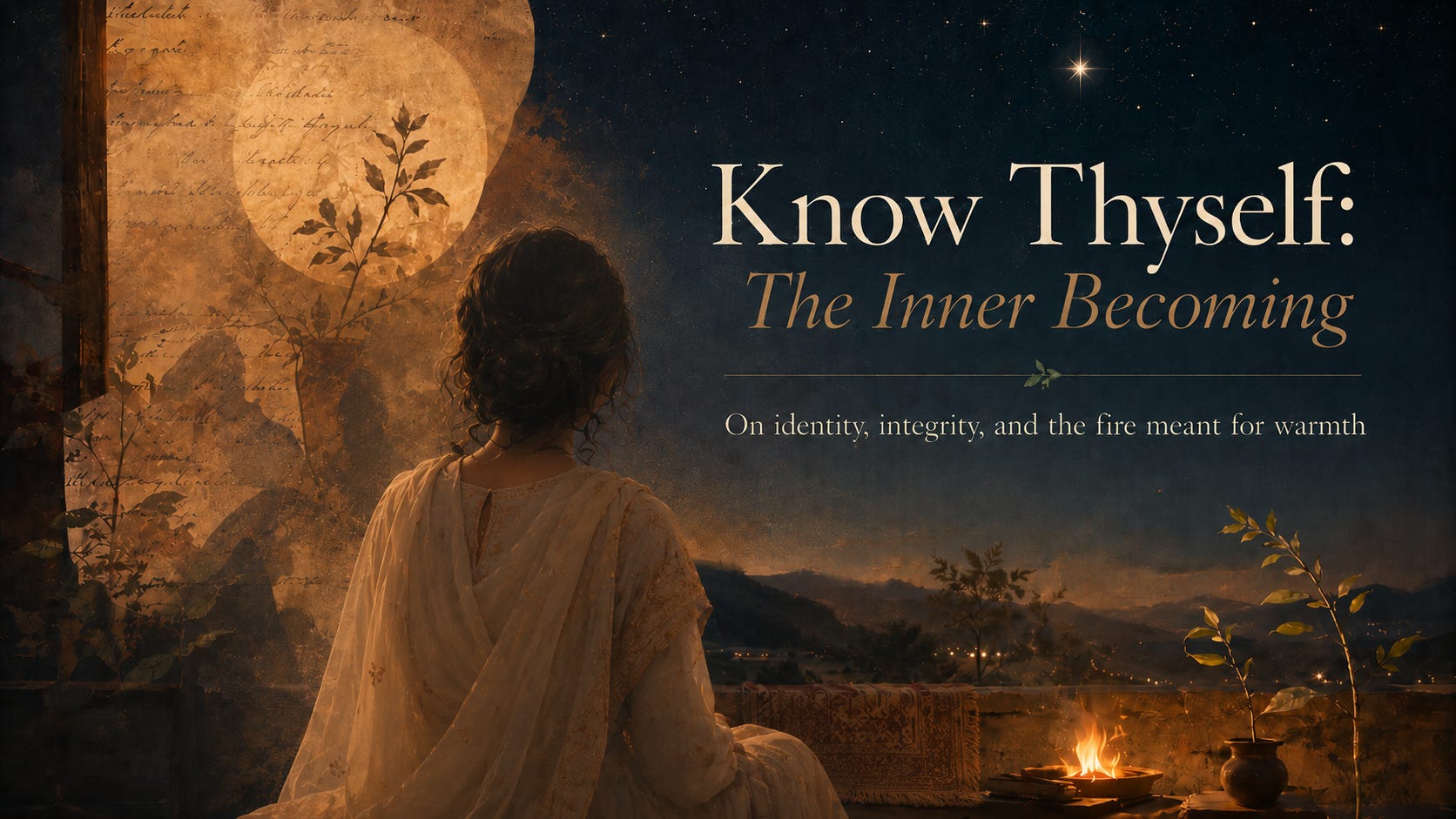
Know Thyself: The Inner Becoming
The Social Monk-Part 4: On identity, integrity, and the fire meant for warmth

I Am Swati Thakur
For years, I was never very happy with my name.
Swati is so common in India that once, when I went for a DRDO exam, there were two rooms full of Swatis. Every possible surname combination. As a child, it sometimes made me feel ordinary. Like something that disappeared into the crowd before it had a chance to be seen.
Now I face the same challenge in a completely different world. On the internet, where names become search terms and identities, a common name can feel like standing in a crowd and shouting your own name while no one turns.
And yet, Swati has a meaning I have started to appreciate.
Swati is often understood as self-going, independent, free-moving. Swa points toward the self, and the name carries the feeling of movement, of flowing and finding one’s own direction. Its nakshatra symbol is a young plant shoot bent by the wind: fragile, yet unbroken. One of the bright stars of the night sky.
Life doesn’t happen to us. It happens for us. My parents chose this name without knowing I was astrologically born under this star. But it carried something I would spend years growing into: independence, movement, and a quiet beneficence.
The name I once thought was too ordinary was, quietly and inexplicably, always mine.
In India, we grow up with many pet names. Within the same family, my parents called me Ruhi, my paternal side called me Ruma, and my maternal aunt called me Loni.
Ruhi means soul. Spirit. The breath of life. From the Arabic rūḥ, it carries the feeling of inner essence, something soulful and unseen that feels, remembers, loves, and keeps searching for meaning.
Ruma carries beauty, grace, and softness. Radiance, tenderness, morning light. Something gentle.
Loni, for me, carries the lioness. Strength, courage, sweetness, and the instinct to rise when life demands it.
When I look at these names together, they feel less like separate labels and more like different phases of life.
Swati, the star. Ruhi, the soul. Ruma, the grace. Loni, the lioness.
Four names. One life. And each one somehow true.
It makes me wonder: do names influence us?
When we name a color blue, we assign it a particular wavelength. When we name an emotion, we give it a form we can finally work with. Once named, the experience becomes more real, more accessible. Language doesn’t just describe reality. It organizes it. Sometimes it shapes how we inhabit it entirely.
Names work the same way. They carry meaning, memory, expectation, culture, and sometimes something that feels like quiet prophecy. This is why choosing a name or an identity intentionally can be a form of self-authorship. A writer. A healer. An artist. A named self becomes a bridge between who we have been and who we are still becoming.
We are the storyteller, not just the story. Always larger than any label or role we step into. Used well, a name becomes a mirror, an invitation, a way of gathering all the versions of ourselves that life has handed us, and finally belonging to them all.
Maybe that is where identity begins to deepen: when a name stops being only what we are called, and becomes a question about what kind of energy we carry. What we do with it.
And what we carry in that named self, that is where the fire begins.
The Fire That Was Meant for Warmth
Fire may be one of the most important discoveries in human history.
It can burn a forest to ash. When it touches the skin, it hurts. It can destroy homes, land, and entire lives. Yet the same fire cooks our food, keeps us warm, illuminates the darkness, brings people together, and helps us survive.
That is the nature of fire. Its undeniable duality.
And that same duality lives in us.
We all have a choice. We can be kind or selfish. We can honor someone’s trust, or exploit it. We can become a co-creator in someone’s growth, or the person who makes another person’s life heavier.
Knowing oneself is not only about recognizing what is good in us. It is also about understanding that the power we carry can move in both directions.
The same person who knows how to build something also knows how to break it. If you understand the blueprint, you know what holds it together. You know the weak points. You know what needs care, and what can bring everything down.
That is why strength without consciousness can become dangerous.
Strength alone is not virtue. Intelligence, knowledge, charm, and access are not inherently good. They become meaningful only when guided by awareness.
Without that awareness, kindness can become performance. Intelligence can become manipulation. Strength can become domination. Even love can quietly turn into control.
This is where people lose their way. Not always because they lack intelligence, but because they lose awareness. They stop seeing the impact of what they do. Slowly, they begin to act as if their choices touch no one but themselves.
Each of us carries that fire.
And because we carry it, we have to ask: Who do I want to become? What kind of energy am I adding to the world? Am I using what I know to build, or am I using it in ways that harm, even when they benefit me?
Every choice leaves a trace. In our relationships, in our work, in our children, in our own nervous systems, and in the way we move through the world. We may not always see the impact immediately. But impact is always created.
That is why awareness must come before action. Responsibility before power.
That fire was always meant for warmth.
But for that, we need wisdom. We need to know what we are carrying, and why.
Thakurain, Loyalty, and Wisdom
In school and college, people called me Thakurain. Sometimes Thakurani.
Maybe because I had that slightly old-school relationship with keeping my word. Very pran jaye par vachan na jaye energy: one may lose their life, but not their word. If I said something, I tried to stand by it. It spoke of integrity.
There were times I was teased for being too upright, as if it were a funny quirk, an unnecessary seriousness. Sometimes I wondered if I was being naive in a world that had quietly made peace with bending the truth.
But over time, I learned something: integrity is not only a moral choice. It is also a biological one.
When we do not lie, when we follow through on what we say, the body reads that as safety. We do not have to remember different versions of the truth. We do not have to live in quiet fear of being found out. The nervous system can exhale.
People who consciously reduce dishonesty report fewer physical complaints and less stress. Lying shows up in the body as elevated blood pressure and stress hormone reactivity. The nervous system keeps the ledger even when we think no one is watching.
And it is not only the lies we tell. When someone else is consistently dishonest with us, when their words and actions do not match, when we cannot predict what is real, the body registers that too. Unreliability in our environment reads as threat. The nervous system stays braced.
This is why, even without saying it out loud, most of us long for at least one person whose word truly means something. In a world that often feels unpredictable, there is a quiet kind of relief in knowing someone is steady. Someone who does what they say. Someone who shows up as they are. That kind of reliability does not just build trust. It creates emotional safety. And with that, life feels just stable enough to face everything else.
What looks like doing the right thing for others is also, quietly, a form of self-care.
There is a line that surfaces in unexpected places, including a John Wick movie: how you do anything is how you do everything. The way you hold one small commitment is the way you hold your life. The way you honor a word to someone else is how you eventually learn to honor yourself.
Being Thakurain gave me discipline, trust, and a sense of inner ground. But I also had to stop punishing myself for every missed promise.
Sometimes it is just misalignment.
Sometimes it is simply that I need rest, or grace, or a different pace.
Commitment is not about never missing. It is about listening honestly to where you are, giving yourself grace when you need it, and returning to what matters without turning every pause into a failure.
A soft heart needs boundaries.
A generous nature needs discernment.
A person who keeps her word also has to ask: to whom, and at what cost?
The same warmth that builds a life can quietly burn through one.
So when I hear Thakurain now, I do not hear a joke.
I hear a reminder.
My loyalty, my word, and my warmth were never meant to cost me myself.
They were meant to hold others, and hold me too.
To love others without leaving myself.
To serve without disappearing.
To keep my softness, but add discernment.
To stay warm, but not become available for everything.
Inner Knowing
Maybe this is where inner knowing begins.
Not in some dramatic revelation. Not in a single moment of clarity that changes everything. But in the quiet honesty of noticing what strengthens you and what drains you. What feels like love, and what is self-abandonment wearing love’s face.
There is a particular irony in knowing how to understand others before we fully understand ourselves. We can become fluent in reading people, patterns, and emotions, while some parts of our own life remain quietly unexamined.
This is not hypocrisy. It is human.
Sometimes knowledge grows outward before it turns inward. We learn to guide, help, teach, love, and analyze others, but the harder question is whether we have ever aimed that same honesty at the life we are actually living.
Even love asks for this kind of attention. We often treat others the way we wish to be treated, and there is beauty in that. But sometimes love also asks us to notice how another person feels loved. What comforts them. What reaches them. What makes them feel seen. And the same question lives in us. Inner knowing means understanding not only how we give love, but also how we receive it.
To know thyself is not only to know your light. It is also to know your patterns, your thresholds, your old reflexes, and the places where your goodness itself needs protection.
Knowing thyself is not a passive state. It is an act of directed attention turned inward with the same care we bring to anything we truly want to understand.
Most people never truly turn their attention inward.
Not because they are incapable.
Because it is uncomfortable to be both the one who asks the question and the one who has to answer it honestly.
The Social Monk Returns
Just when you think you are done with the world as it was, life invites you into a new relationship with it.
Not the old kind, where you lose yourself in the current of other people’s needs, or follow the map handed to you by parents and society. The one you never chose, but walked anyway. The map that told you who to be, how much to give, what to want, and what to swallow quietly.
But the kind that begins when that map runs out, and you realize the next path has to be carved by you, with yourself still intact.
The social monk is still social. She is present, engaged, and connected. She still laughs at the right moments, still shows up, still cares. What she has learned is how to be in the world without being consumed by it. To give without emptying. To listen without absorbing everything as her own. To stay in the room and still remain herself.
Solitude is not the same as hiding.
Peace is not the same as invisibility.
Discernment is not the same as disappearing.
These distinctions matter because the world will sometimes read your boundaries as coldness, your stillness as absence, your selectiveness as arrogance. It is not. It is the beginning of a more honest way of being present. One that does not perform warmth, but actually carries it.
There is a layer of this journey that only becomes visible once the inner work has begun: learning how to be seen without abandoning yourself. How to speak without overexplaining. How to let your work and your presence reach the people they are meant to reach, without performing for them. How to be known without handing yourself over entirely.
This is another kind of undoing. Not the dramatic kind. The quiet, daily kind, where you catch yourself shrinking out of habit and choose differently.
The social monk does not leave the practical world forever.
She returns with a clearer self.
She knows what she is here for, what she will not trade away, and who she is when no one is watching.
And this time, she brings herself along.
Become the Becoming
After all the learning and unlearning, the question becomes quieter and clearer.
Who am I?
Not as one fixed answer. Not as one permanent label. Not as a role that contains everything.
I am the child shaped by fables. The girl who changed schools and learned to read new rooms. The woman who crossed languages, borders, and systems, and found her way each time without losing the thread of herself. The woman who kept her word even when it cost her, and had to learn that keeping her word to herself matters just as much.
For a long time, I thought knowing myself meant returning to the happiest version of me. And part of me still believes that matters. The child who felt safe matters. The girl who dreamed matters. The student who adapted matters.
But I think now that knowing thyself is not only about returning.
It is also about becoming.
Becoming the person who can hold all those versions without needing to order them. Who can say, that was me too, without apology or performance. Who no longer rejects past versions of herself because they were doing the best they could with what they knew.
The thread running through a life is rarely a title, a country, or even a language.
It is the part of a person that keeps learning, adapting, questioning, and beginning again. That quality, not any single achievement, is the thing worth knowing.
Maybe that is what Know Thyself means, finally.
Not arriving at one fixed answer.
Not becoming a finished person.
But becoming intimate with the becoming itself.
To know the fire.
To know the softness.
To know the patterns.
To know the possibility.
And then to keep walking.
Not as someone lost.
But as someone who finally knows what her fire is for.
Further Reading
If you enjoy the science behind this reflection, you’ll find a few reference papers and resources linked :
Carney DR, Cuddy AJC, & Yap AJ. “The Physiology of (Dis)Honesty: Does it Impact Health?” Current Opinion in Psychology, 2015. https://faculty.haas.berkeley.edu/dana_carney/physio.dishonesty.pdf
“The Psychology of Betrayal: Why It Hurts So Deeply.” Impact Psychological Services. https://www.impact-psych.com/blog/the-psychology-of-betrayal-why-it-hurts-so-deeply
“Effects of Betrayal on the Brain: How to Heal Your Mind and Body.” Integrative Life Center. https://integrativelifecenter.com/intimacy-disorders/effects-of-betrayal-on-the-brain-how-to-heal-your-mind-and-body/
American Psychological Association: Lying Less Linked to Better Health, New Research Finds
https://www.apa.org/news/press/releases/2012/08/lying-lessUniversity of Notre Dame: Study: Telling Fewer Lies Linked to Better Health and Relationships.
https://news.nd.edu/news/study-telling-fewer-lies-linked-to-better-health-relationships/Leanne ten Brinke, Jooa Julia Lee, and Dana R. Carney: The Physiology of (Dis)Honesty: Does It Impact Health. https://www.sciencedirect.com/science/article/abs/pii/S2352250X15001980
University College London: How Lying Takes Our Brains Down a “Slippery Slope” https://www.ucl.ac.uk/news/2016/oct/how-lying-takes-our-brains-down-slippery-slope
Looking at how our past versions and different names connect is a huge eye opener, honestly.. Learning to keep our inner warmth without letting it burn us completely out is a lesson most of us spend a lifetime trying to figure out. Beautiful article and PS:- swati name fits in every generation :))
This resonated deeply with me. Lately, I’ve been noticing myself more than judging others. For a long time, I was quick to label people, but I’m beginning to see that many of those judgments were also reflections of something within me. When that realization came, my attention gradually shifted inward.
What I loved about your piece is how it shows that we are far more than a single label or identity. Just as your different names reveal different facets of who you are, each of us carries many dimensions within us. Perhaps self-discovery is not about choosing one identity, but about becoming aware of them all and learning how to carry them consciously.
Beautifully written. Every section felt connected to the central idea of knowing oneself.